How Scarlet Witch helped me deal with baby loss grief

My body. My mind. My power.
Writer's Note: As a trans person, I am very aware that a person's gender is not defined by their chromosomes or secondary sex characteristics. However, when discussing scientific research in this article, I use the language of the study's authors to accurately reflect operational definitions used in research (and hopefully, draw attention to biases in health research, too).
It’s Baby Loss Awareness Week. Below is my story, as told through the lens of my favorite Marvel character, Scarlet Witch.
Now a devout Scarlet Witch superfan, I wasn't introduced to the character until 2016. Although many of the details of my first viewing of Marvel Studios' 2015 Marvel Cinematic Universe entry, Avengers: Age of Ultron, have faded due to an acute brain injury in 2024, the excitement still lives in my body. Just thinking back to that initial viewing causes a surge of adrenaline and excitement, positive feelings that I have used to ground myself throughout my own arduous journey with infertility and child loss.
While on a 2016 vacation in San Diego, California, with my wife, Avery Kaplan, my body did what it often does in response to stressors, both positive and negative: it shut down. While Avery explored the city, I lay in the hotel bed and watched Age of Ultron for the first time. Then, immediately hooked on the hex magics, I watched it again, and again, and again, and again, loving (relating?) every moment of Elizabeth Olsen's portrayal of telekinetic goth girl Wanda Maximoff's trauma.
“Where are my children?"
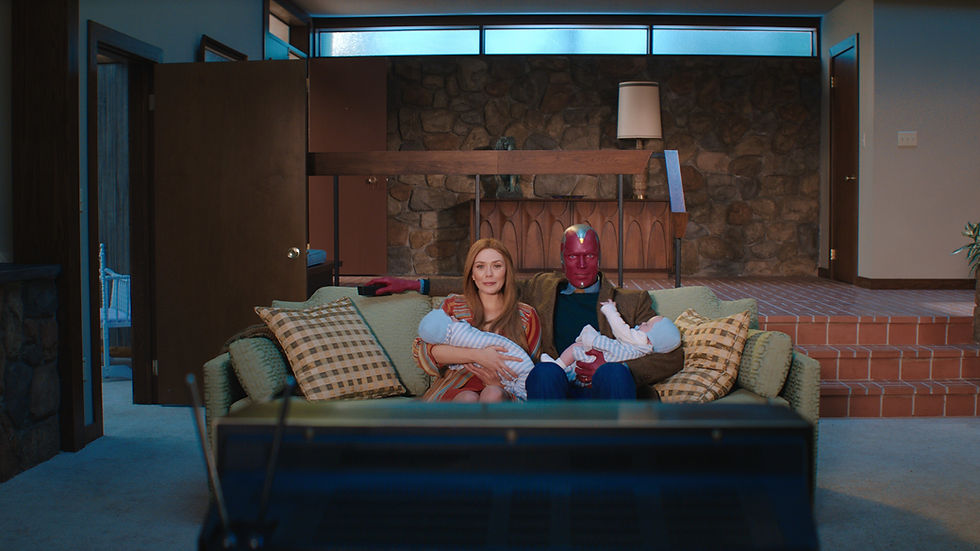
While I am not inclined to separate the art from the problematic artist, a.k.a. Ultron director Joss Whedon, it’s undeniable that the movie had a profound impact on me when I first watched it. I've written about it here, here, and here. However, I don't think I've ever publicly written about my own experience with an ectopic pregnancy, the traumatic loss of a child, and the emotional impact of learning you're infertile and won't be able to try again.
Model Chrissy Teigen started the conversation about the emotional impact of child loss in 2020, and the lack of social support for grieving parents. "I cannot express how little I care that you hate the photos," she wrote in a blog post, following the revelation that she had taken photos of her abortion, although at the time she believed it was a miscarriage. "How little I care that it's something you wouldn't have done. I lived it, I chose to do it, and more than anything, these photos aren't for anyone but the people who have lived this or are curious enough to wonder what something like this is like."
And just because I'm trans masc/genderqueer, it doesn't mean that bearing children was any less important to me: I just wasn't born with the privilege of a working reproductive system.
In my early 20s, I was prescribed birth control pills to deal with chronic pelvic pain. Shortly after switching contraceptive methods, I got pregnant, unaware of the endometriosis ravaging my body (the disease, which impacts roughly 10 percent of AFAB people worldwide, can mess with estrogen production and complicate the effectiveness of oral contraceptives, or at least that's what doctors have told me). As much as I wanted to have the child, it was an ectopic pregnancy, and like with all ectopic pregnancies, an abortion was necessary to save my life.
However, despite the medical necessity of an abortion when a pregnancy is ectopic, one of my charge nurses told me that terminating my ectopic pregnancy was a choice, and the wrong choice, amounting to murder. After all, as her story went anyway, some ectopics do come to term. Well, not some, ONE did (allegedly), but that technicality didn't matter to her, an abortion is an abortion, no matter the reason.... and therefore, murder.
Years later, I found a long-forgotten diary entry I wrote that day: I was young and naive and believed her.
Since I felt it was my fault, I battled my grief for a long time, refusing to shed a tear even when I realized that the ectopic pregnancy was my only chance at creating life (and no JKR, the fact that I don't have a uterus doesn't make me less than). This is known as delayed grief, when someone might not feel sadness over a loss for days, weeks, months, or even years, and it's typically associated with an unexpected trauma (e.g., the sudden loss of a loved one).

For more than 10 years, I refused to acknowledge how traumatic my fertility experiences have been. It's normal for emotional numbness to accompany delayed grief related to loss. Just like Wanda says to her brother Pietro about the loss of her lover in WandaVision, the trauma of loss takes its toll and can lead to feelings of "endless nothingness."
And this endless nothingness was compounded by the guilt and shame that I was made to feel at the time. And, in retrospect, that was not okay. I was robbed of my autonomy and voice, and I will not be robbed of that power again. It’s my body, my mind.
While society encourages holding in grief, it's unhealthy. According to the Psychology Today article "Expressing Grief vs. Holding It In," research shows that when parents who have suffered from child loss hold in their grief, each parent's grief is more intense.
"Scientific evidence indicates that bereaved parents are more likely to suffer more depressive symptoms, poorer well-being, less purpose in life, more health complications, marital disruption, psychiatric hospitalization, and even premature death for both mothers and fathers as early as age 40," according to Evermore, an organization promoting the rights of bereaved Americans.

In the Disney+ series MPower, Olsen said that having a family is Wanda's "ultimate need," making it the why of WandaVision and Doctor Strange in the Multiverse of Madness. But while the character deeply wants connection, family, and peace, she constantly loses the people she loves: her parents, twin brother, lover, and sons.
Many AFABs like me can probably relate to Wanda's response to the loss of her and Vision's twins, Billy and Tommy. Sixteen percent of pregnancies end in a miscarriage or stillbirth in the United States alone, per the CDC's National Center for Health Statistics. Additionally, approximately 22,000 babies die before their first birthday annually (known as infant mortality), with Black babies experiencing a significantly higher IMR than their white counterparts. For the 25 million women living in states with abortion bans and restrictions, the infant mortality rate is even higher.
I can't speak for every woman. However, I will note that when I discuss how I relate to the trajectory of Wanda's grief from WandaVision to Multiverse of Madness in grief and loss support groups, many women violently nod in agreement. Thus, Wanda's story is one I have been able to use to bond with others going through something similar, offering me a connection even beyond my parasocial relationship with Scarlet Witch (by the way, forming parasocial relationships with our favorite characters helps depression).
"You break the rules and become a hero, I do it and become the enemy."
While trauma is frequently central to the stories of male superheroes, the traumatic experiences of female heroes are often largely unexplored, or when touched upon, they aren't handled with nuance and depth. Relevantly, in Age of Ultron, Natasha makes an off-hand reference to her forced infertility, or what is better known as genital mutilation, citing it as the reason it's easy for her to kill people. Instead of treating this trauma with the reverence it deserves, her infertility is used to cement the idea that women without uteruses are somehow less than human—they're monsters.
"Contrary to the interpretation of most (outraged) feminists, what makes Black Widow tragic is not that she does not aspire to motherhood, but that she has no choice either way," anarchist think tank Center for a Stateless Society wrote in 2015. "Black Widow’s forced infertility stands for a problem that plagues our society: the external loci of control over women’s bodies."

Unlike Natasha, from what we know of Wanda's story, she's not infertile herself. Instead, it's her lover and husband, Vision, who cannot bear children (about 30 percent of fertility problems begin with men, per Better Health Channel). Thus, her story is also about women and the choices they can make. When Earth-616 Wanda learns that Wandas across the multiverse could have children, she feels she should also be able to exercise her right to choose. "You break the rules and become a hero, I do it and become the enemy," she tells Stephen Strange about her decision to use the Darkhold to go after her children. "That doesn't seem fair."
"The U.S.-centric view that women now fully own themselves is simply not accurate, even in the West," continued the Center for a Stateless Society article. "Thanks to legal obstruction, social norms, and male entitlement, women still do not have complete control over their bodies."
And that statement is more true than ever in the Year of Our Orange Overlord, aka 2026.
One of the most apparent ways AFAB people don't have control over their bodies relates to reproductive rights. With the fall of Roe v. Wade, 12 states in the U.S. have enacted abortion bans, and 25 states are considered hostile to abortion, making it difficult to exercise the right to choose in well over half of the American states. While it's still currently legal to travel to another state for an abortion, at least according to Planned Parenthood, if you're AFAB and under the age of 18, you're still required to get parental consent to have an abortion. And, in these states, women who attempt their abortions may be charged with criminal homicide.
These laws further enforce the idea that women don't have control over their own bodies. Like Natasha, AFAB people living under these abortion restrictions do not have the right to choose whether or not to have children. With these laws, the U.S. government is exercising its parens patriae power and making that choice for them. And now, with U.S. President Donald Trump's Project 2025, even more of these freedoms are under attack, including access to birth control, access to fertility treatments, access to emergency abortion care, and more.
"Power without compassion—that's the danger."
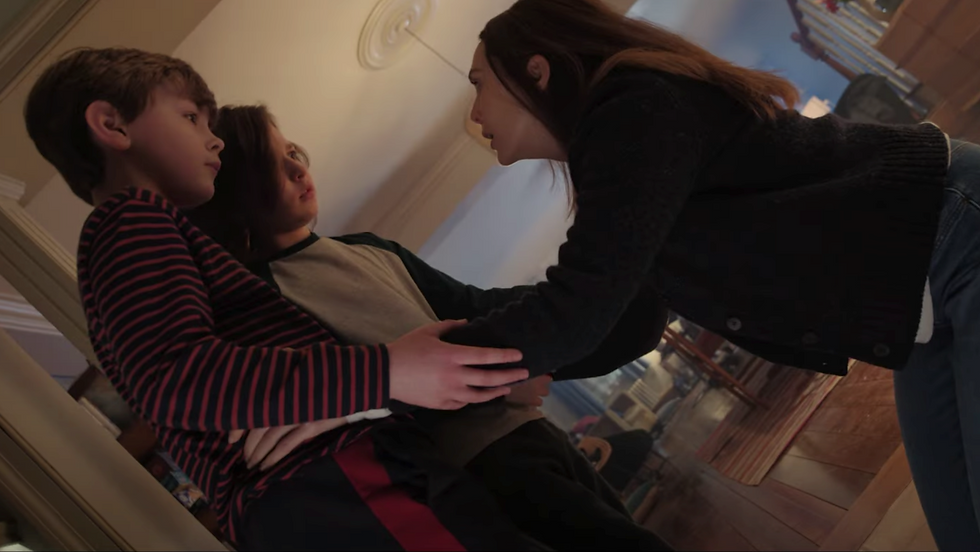
Wanda came from an immensely traumatic childhood and didn't grow up with a stable, loving family with the resources to meet her childhood needs.
Then, in Age of Ultron, Pietro dies saving Hawkeye and a child, utterly destroying her, and her response—collapsing in grief and destroying Ultron bots with a scream—is the first time we see how her traumatic past fuels her powers. Indeed, her entire arc—from Age of Ultron to Multiverse of Madness—is essentially a study of how complex post-traumatic stress disorder, or C-PTSD, can shape someone and lead to post-traumatic growth, at least under the right circumstances.
Because of her childhood trauma, Wanda has always sought a community, even when she didn't realize she was doing it. In the Multiverse of Madness, she wants to recapture this family nucleus she created in WandaVision. "If you knew there was a universe where you were truly happy, wouldn't you want to go there? I want to leave this reality and go to one where I can be with my children."
WandaVision and Multiverse of Madness demonstrate to viewers that people don't move through the stages of grief in a straight line.
WandaVision took Wanda through each stage of grief. Episodes 1–3 are in the denial space, mimicking post-war optimism. At the end of episode 3, Wanda enters the next stage of grief, anger, which impairs her judgment. Episode 5 is the big bargaining moment when Wanda storms out of the Hex and confronts Hayward. The next stage, depression, starts with episode 7 and leans into depression tropes, like a girl who's been dumped but can't keep it together ( "This is probably just a case of the Mondays, am I right?"). Finally, the acceptance stage comes when Agatha gives Wanda tools to process her grief, including the Darkhold, or the Book of the Damned, which states that her power exceeds that of the Sorcerer Supreme.

At the end of WandaVision, faced with the impending destruction of the world she's created, she truly begins to process her pain, fueling her transformation into the Scarlet Witch. It's a huge step toward accountability, but she leaves "broken, alone, and tempted by the Darkhold," a dangerous magical book. When the post-credits scene shows her studying the Darkhold, it's as much about the magic as it is about learning about herself.
By the time we see her in Multiverse of Madness, Wanda is once again struggling with her trauma. Consumed by the idea of stealing another version of her sons from the multiverse, her morality slips—she kills, threatens, and nearly destroys entire realities. However, when she sees how terrified her "other" children are of her, Wanda realizes the monster she's becoming, reverses course, and appears to sacrifice herself to destroy the Darkhold.
Like many who struggle with C-PTSD, she struggles with trust, closeness, and problem-solving, hindering healthy communication patterns. Olsen continues in MPower, "We can all relate to feelings of loneliness and abandonment in different aspects of our lives and feeling like there's no bottom to hold to."
Everyone experiences loss; exploring that with the characters you love can be cathartic.
Although everyone must eventually confront grief to heal, it can be a source of strength. Like how Wanda had to go through it to become the Scarlet Witch. This is where she uses the most power she has yet, and it's for the love of her children. She's not evil—just overwhelmed, emotionally wrecked, and way too disassociated to realize the way that she’s processing her pain is hurting others. Although she's superhuman, her trauma is human and relatable. For better or worse, everything she does is rooted in the universal desire not to be alone in the pain. She's "hurting," not evil.

While most superhero stories center around the highest stakes traumas, the real human experiences of love, loss, grief, and trauma are where Wanda shines. As she comes into her own as the Scarlet Witch, her grief and desperation to be reunited with her children—even if they exist in another universe—is amplified by the Darkhold, a representation of C-PTSD's darkside: an inability to accept powerlessness, causing a person to become overly controlling in situations to compensate for the lack of control they experienced during trauma.
In the MCU, Wanda is most powerful when she's vulnerable, and she teaches us that we are the source of our own power. The character is unique because she's not easily boxed into any category—she has been a villain, hero, mother, goddess, and pariah. In other words, her experiences capture the contradictions of being born AFAB.
On the negative side, Wanda's story can be viewed as one of female hysteria.
"The way I like to think of [Wanda's] arc is through mental health," said Olsen in MPower. "We're in this amazing time of embracing mental health, and it is becoming less taboo to use the language of depression, and panic and anxiety," she continues. "The more we can tell stories about it, the people having these experiences, potentially could stop feeling shame or isolation, and that's a very important topic to me because it's everywhere, and we don't see it because it's private."
Scarlet Witch embodies the feminine ideal, as cis men write it: she's beautifully broken, always walking the tightrope between redemption and ruin. However, she taught me that I will never go quietly, ever again. My body. My mind. My body. My mind. My power.
Capital Women's Care has a great list of support resources if you are dealing with grief and loss after a miscarriage, stillbirth, or death of a child.


Comments