Review: NARROW ROOMS is a manhwa you feel in your teeth

Content warning: This review discusses sexual harassment, stalking, and trauma responses in detail.
Choi Sungmin's Narrow Rooms — originally serialized as a webtoon in Korean, translated into English by Janet Hong, and collected by Drawn & Quarterly — is a manhwa that stays with you long after you've read it.

Narrow Rooms follows Daye, a high school student whose art director is sexually harassing her — leaving her gifts, sending unwanted messages, and physically cornering her at school. Unable to stop or escape it, she channels the trauma sideways: she becomes obsessed with a male neighbor, going as far as digging through his trash, sneaking into his room while he's passed out, and reading his mail, just to feel like she has control over something. The book also follows Daye’s foil, a classmate facing the same harassment from the same art director, who instead responds to the harassment by accepting the director’s advances in exchange for scholarship money. While Daye initially judges her for it, overall, the story's point is that there's no "correct" way to survive trauma — just whatever coping mechanism is available to you in the moment.
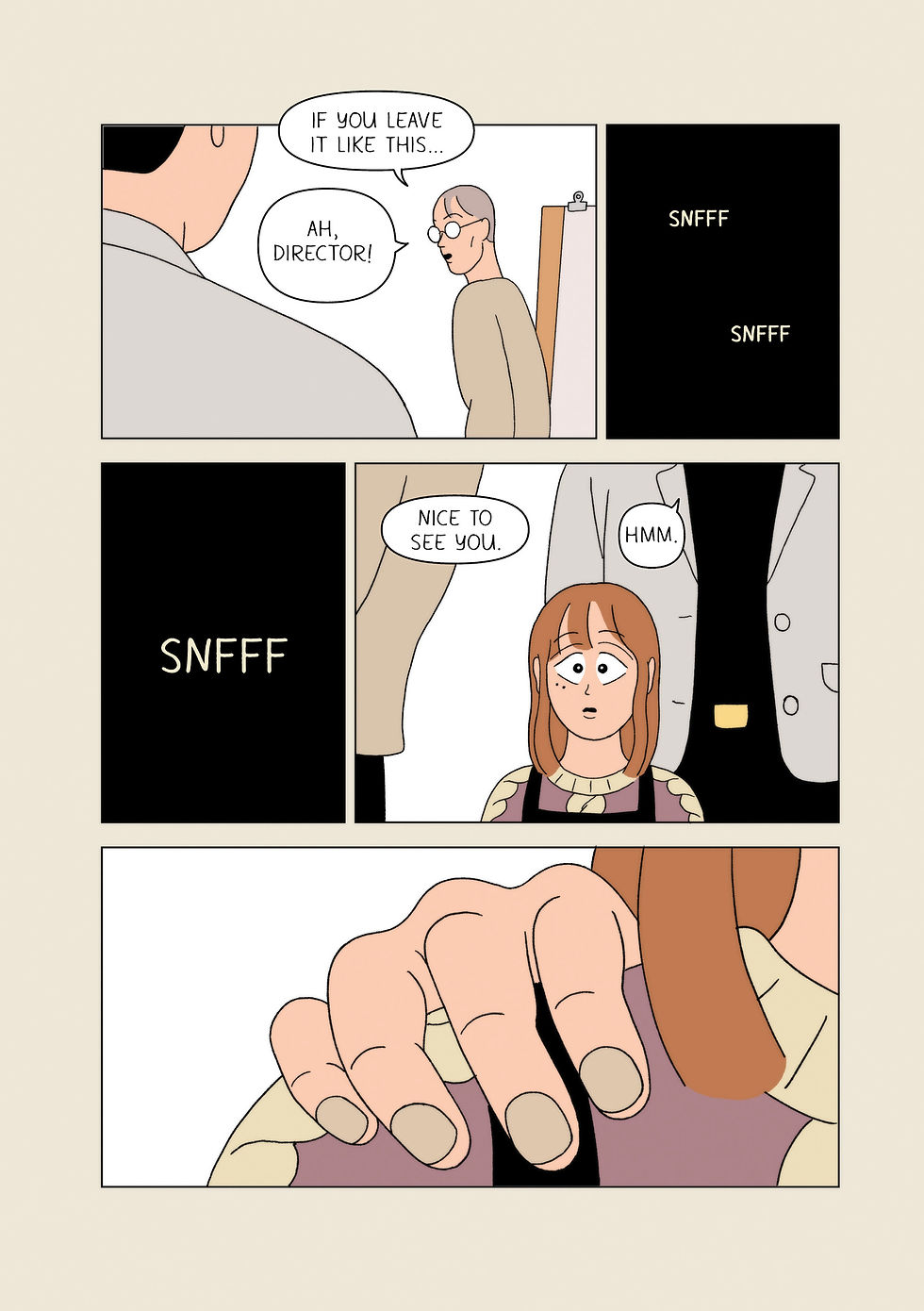
Formally, it uses panel pacing and framing to put the reader inside the dread of an assault before it happens — panels narrowing, focus tightening on small physical details (a hand, a sniffle) as the aggressor closes in. This artwork mimics traumatic memory so well that it leaves you with an uncomfortable, metallic taste in your mouth — a taste that seemingly comes from nowhere, then gets stuck on your tongue no matter how much you try to wash it out. It’s the unique taste of a memory of one’s past trauma, and the taste of human behavior going horribly awry…. And that taste memory sears itself into your mind's eye.
Narrow Rooms is that memory. It takes the reader down a lane they may prefer not to walk — into the uncomfortable recesses of their own history, back to a time when they acted inappropriately, or a time when their own trauma came out in a way they later wished it hadn't, uncomfortably close to the toxic or abusive relationship it sprang from. A shadow of the trauma’s source, once again acting through you (whether you want it to or not) no matter how hard you’ve worked to leave behind — but the body keeps score and has a nasty habit of reminding you every once in a while that it exists… seemingly to put you back in your place.
Every art decision in Narrow Rooms drives that discomfort home further, and those choices shape the entire reading experience. That discomfort doesn't mean the book isn't enjoyable — it's just a difficult read, one backed by technical and artistic achievements that push the uncomfortable points even deeper.
The art of dread
The pacing of the panels in Narrow Rooms mimics how time flows in the moments before an assault or an act of harassment, a cruel trick the mind plays on the victim in an act of self-preservation. You're aware trauma is coming. In theory you could do something about it, save yourself, control the uncontrollable — and so time slows so that you feel a sense of control, but it’s control that isn't really there. It doesn't actually protect you; it just makes you more aware of the aggressor, not more able to stop him.
Narrow Rooms' art mimics that same discomfort, with the aggressor's hand taking several panels to reach the victim's unassuming shoulder.
Early in the story, we're introduced to our protagonist's perpetrator through a small gift: a gold watch left inside Daye’s locker. She immediately throws it away and goes to the bathroom to scrub herself clean, thinking, “I hate this.” As the pages progress, the panels narrow their focus to details that signal the school's art director (her harasser) closing in. One panel lingers on his feet stomping toward her; the next, on the back of his neck. Several all-black panels are interspersed throughout these scenes, each entirely taken up with the sound of his sniffling as he approaches. Then, over a page where the panels shrink and multiply, his hand finally lands on her shoulder. And as you turn the page, you see him looming over her, larger than life, entirely outside her control — then, suddenly, the panels cut back to the sniff, sniff, sniffing of the art director, as if he's trying to take in her scent, or to remind her he's always there.

All this happens as she dissociates into an image of a reindeer being separated from the herd. Cornered. Afraid. Uncomfortable. An effective rendering of the overwhelming isolation of constant, harassing, and unwanted attention from another.
In another scene, as the art director closes in on her again, the artist draws — with painstaking, leisurely attention — the crumbs accumulating around his mouth as he corners Daye at a coffeehouse outside of school hours, a sequence of images engineered to disgust, and one that sears itself into the reader's mind whether you want it there or not.
While I mostly really enjoyed Narrow Rooms (despite the discomfort) this is the one image choice I could have done without. It lands the emotional gut-punch the creator was clearly going for, but linking a male aggressor's “gluttony” with food to an "insatiable," predatory sexual appetite inadvertently strengthens deeply rooted, moralized frameworks about bodily consumption that research shows can backfire, reinforcing harmful societal biases — even when the intent is to condemn a predator rather than a victim.
Historically, equating food consumption with moral failing or a lack of discipline feeds directly into anti-fat bias and fatphobia. By using "gluttony" as a shorthand for monstrosity or moral rot, it reinforces the harmful stereotype that a person's size, weight, or relationship with food reflects their ethical character or capacity for harm.
Even when the explicit goal is to make a villain look repulsive or condemned, relying on the "gluttonous predator" trope keeps the conversation anchored in outdated ideas about bodily purity and temptation, rather than the actual ethics of consent, autonomy, and harm. Sticking to explorations of a character's entitlement, obsession with dominance, or lack of empathy provides a much more accurate and less structurally harmful depiction of aggression.
Two ways to survive the same room
What makes Narrow Rooms especially interesting is how it maps different responses to the same trauma.
A foil to our protagonist Daye faces the same demands from the same art school director, but instead of rejecting his advances, she accepts his offer of scholarship money in exchange for sexual favors. Having been in similar situations myself, I can say that sometimes, to regain a sense of control, a victim gives in to the advances — or even initiates the contact — because the contact is going to happen either way. Initiating it becomes a way of taking back control when another’s behavior is something you can't otherwise stop, because at least then you know when it's coming, and you can brace for the pain.
The protagonist judges this response in her classmate, seeing herself as better for having refused the art director's advances. But the book's message is clear: that judgment is misplaced. There is no right way to cope with trauma. There is only the best any of us can do with the psychological resources we have at the time. Her classmate's choices weren't a moral failure; they were another way of trying to seize back control over a life that had been taken out of her hands.
Negative, unconscious memories don't get processed normally. Traumatic memories don't fade the way ordinary ones do — they remain an active, unconscious force shaping behavior. We see this play out directly in our protagonist's arc: in response to the harassment at school, she begins stalking her neighbor, growing obsessed with him to the point of committing small crimes just to learn more about him. She digs through his trash at night. She sneaks into his room while he's passed out drunk. She listens to his conversations through the apartment wall. She goes through his mail. Any action that brings her closer to him is one she's willing to take.

The obsession gives her somewhere else to put her focus, something that feels like it's within her control, unlike her own trauma. And as her world shrinks around this fixation, the art shrinks with it: her room narrows on the page, literally, along with the reader's field of view. While this obsession takes up most of the story, it’s not the point of the story. Instead, it’s there to drive home the point that sometimes the way we respond to trauma isn’t the best.
Narrow Rooms is currently available from Drawn & Quarterly.


Comments