Review: Mike Flanagan’s CARRIE makes its heroine a symptom of something bigger

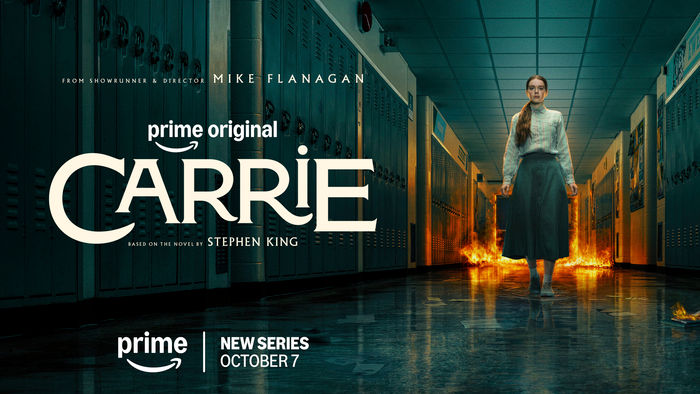
Stephen King’s Carrie doesn’t lack live-action adaptations. There’s Brian De Palma's 1976 film, the 2002 TV movie, the 2013 remake, and even a (very memorable) Broadway musical. However, Mike Flanagan isn't interested in retreading the telekinetic-revenge story. His eight-episode Prime Video series, from Amazon MGM Studios, is the first time King's novel has been adapted as a TV series. It argues Carrie White isn't the horror; it’s the systems around her.
Carrie was King's debut novel, launching a career that's sold more than 350 million books worldwide. Carrie spent 14 weeks on The New York Times Best Seller list and has since been translated into more than 35 languages. And with De Palma's Oscar-nominated film turning 50 this year, Flanagan is stepping into a very big pair of shoes. The trailer's tagline question, "What happened in Chamberlain?", and the series delivers on that promise, complicating what we think we know about Carrie and the night everyone already knows is coming.
Mike Flanagan's Carrie cast: who plays Carrie White, Margaret White, and Chris Hargensen
Summer H. Howell plays the titular Carrie White, a misfit shoved into public high school after her father's sudden death. The search for the role saw nearly 1,500 actors read. Samantha Sloyan is Carrie's mother, Margaret White, and the two are co-central victims here, but far from the only ones. Alison Thornton plays Chris Hargensen, Siena Agudong is Sue Snell, Joel Oulette is Tommy Ross, and Amber Midthunder is gym teacher Miss Desjardin. Josie Totah, Arthur Conti, Thalia Dudek, and Matthew Lillard (as Principal Grayle) round out the ensemble.
Recurring guest stars include Michael Trucco (Fire Country), Crystal Balint (The Fall of the House of Usher), Kate Siegel (The Haunting of Hill House), Rahul Kohli (We Were Liars), Tim Bagley (The Comeback), and Heather Graham (The White Lotus), a mix of longtime Flanagan collaborators and newcomers to his circle.
Monstrous-feminine meets final girl: how Flanagan reframes Carrie

Scholars have long argued that the ultimate site of horror in King's novel is Carrie’s body. It's Carrie's body, which commits the "sin" of becoming visibly, uncontrollably female, something that starts to happen before Carrie ever flings a car or burns down a gym. Julia Kristeva's abjection and Barbara Creed's monstrous-feminine practically wrote themselves around a story where a first period gets treated as an obscenity.
Kristeva's 1980 book, Powers of Horror: An Essay on Abjection, defines abjection as a state of horror triggered by anything that blurs the line between self and world. Blood, waste, and skin are cast off from the body, and they remind us how fragile and material we are. The abject is neither fully object nor fully self. It lives on the border, and that's exactly why it terrifies. It's also why the shower scene works: menstrual blood is a fluid crossing a bodily boundary, and Carrie's classmates react with visceral panic, treating her like a disease to be contained, literally and figuratively. Researchers studying what they call the "menstrual monster" trope argue that horror has trained audiences to expect that a bleeding female body will breed terror. Carrie is the template.
Meanwhile, Creed's monstrous-feminine is the idea that horror often constructs monstrosity not despite womanhood, but out of it—specifically tying terror to female reproduction and sexuality. In her 1993 book The Monstrous-Feminine: Film, Feminism, Psychoanalysis, she argues that horror builds female monstrosity out of womanhood, specifically out of reproduction, maternity, and the female body, rather than treating women as passive victims. Where Freud and Lacan saw women as castrated, Creed sees her as the castrator, an active threat to male authority. She sorts this monstrosity into archetypes, from the archaic mother of Alien and the monstrous womb of The Brood to the vampire of The Hunger, the possessed body of The Exorcist, and the witch, a category that includes Carrie herself. Carrie's telekinesis arrives in lockstep with her first period, and her power isn't some separate force—it's a hormonal, untamed extension of her changing body.
And here's the tragedy: every attempt by those external to the self to suppress Carrie's body triggers its catastrophic expansion.

Margaret White's religious fanaticism and the school's cruelty work like a pressure cooker, and what gets repressed gets unleashed. To Margaret, the blood is proof of sin and the "curse" of Eve, and in the novel, the answer to fixing that "curse" is the closet. To the girls at school, it's a social contaminant that they use to humiliate Carrie and separate her as a social outcast. Then comes the prom, where the infamous pig's blood scene forces the abjection of the locker room into the open. In that moment, the transition is complete, as Carrie embraces the monstrous identity that everyone has pressed on her and turns her body into a weapon of mass destruction.
But Sue Snell, the most compassionate of Carrie's classmates and a strong woman in her own right, is proof that this didn't have to be a monster story. Carol Clover's Final Girl—the watchful, resourceful survivor who outlasts the slasher's killer—is the genre's built-in answer to "who gets to live?" Sue is the closest thing Carrie has to one: she's one of the few students whose saved from the destruction at the gym. But look at how she gets there. Sue is part of that locker room bullying at the beginning of the story, part of the chorus pelting Carrie with tampons, before guilt sends her scrambling to make amends. She never beats the monster. She survives by distance, getting pulled out of the gym before the chaos ensues. What she inherits isn't victory, it's testimony: she's the bridge between "normal" society and the outcast it created, the witness who knows what the cruelty cost.
Survival, Carrie insists, is never clean. The slasher formula needs a clear line between victim and threat, and Carrie erases it: she is both at once. Sue's goodness arrives too late to save anyone, which is the point. The slasher asks who survives. Carrie asks who made her.
A cast full of victims: Chris Hargensen and the abuse storylines

The cast is full of victims. A young male teacher begins an inappropriate relationship with a student, a child-predator dynamic that also victimizes another woman in the story. Chris, the primary antagonist, is a product of family trauma: a narcissistic father and a mother who left, creating a daughter who reads that as abandonment and takes those feelings of loneliness out on others. Her one-woman campaign to wreck Carrie's high school life starts where it does in King's novel, with the shower scene.
The shower scene is faithful and brutal, and it's the series' thesis in miniature. The girls chant "plug it up, plug it up" and pelt a terrified Carrie with tampons, and Miss Desjardin steps in, only to discover no one ever taught Carrie about periods. When the teacher offers materials, Carrie recoils: they're "deep state" contraband, and not okay in the White home. That's not naivete. It's a girl kept ignorant by a household with its own paranoid vocabulary, a rare glimpse of the mother from the book. It also sets a pattern: people keep giving Carrie a "what the f*ck" face when her ignorance shows.
The sharpest critique is institutional, and it has a face: Principal Grayle. Every time he's asked to deal with Chris's bullying of other students and teachers alike, he bumbles it, and the school's responsibility to its students goes down with him. The school fails on the bullying, on the teacher-student relationship, and on the obvious abuse at home. Online bullying is outside a school's reach, but reporting suspected abuse is mandated, and it never happens here.

The one thing the school can do is the thing it won't, and you have to ask why. One answer: the abuse may not be the point of this version. We get glimpses of the domestic violence and trauma-inducing parenting at the heart of King's original tale, but the novel's most striking beats are missing, including the mother's reaction to Carrie's first period and her development. Also gone is the later growth of her "balloons," King's own euphemism for Carrie's body changing, the scenes that trigger her mother's severe reprimand. An adaptation is an argument about what to keep, and Flanagan sketches the abuse without staying in it.
Is Carrie worth watching? the verdict
Yes, Carrie is worth watching. Flanagan treats the story as an indictment, not a revenge fantasy. Rather than placing the blame on Carrie herself, he puts the blame on the adults and institutions that looked away, and it hits. He asks who built the girl that everyone fears, and the answer is a home, a school, and a principal who never stepped up.
You may be asking, "Is Mike Flanagan's Carrie faithful to the novel?" Kind of. For die-hard fans of King's novel, the omissions (and the show's ending) may sting, but the core argument of the story holds. The shower scene is faithful and brutal, the ensemble is stacked, and the institutional critique stings. It does mute the novel's cruelest domestic beats, so if you want the book's full horror, you'll feel the gap. But as an argument about what we owe the Carries of the world, it lands.
All eight episodes of Carrie drop at once on Wednesday, October 7, 2026, exclusively on Prime Video in more than 240 countries and territories, so it's binge-ready with no weekly wait. Flanagan writes, executive produces (with King also executive producing), and directs episodes 101, 102, 107, and 108. Kate Siegel, Axelle Carolyn, Kyra Sedgwick, and Hiromi Kamata direct episodes 103 through 106, respectively.


Comments